
Buying a BCD is probably something that each serious scuba diver considers at some stage. A BCD is a big investment, and with a myriad of choices out there, it can be a daunting task to decide which ones work for you.
BCD’s have all been designed with a specific purpose in mind. Here are some basic guidelines, to help you decide on the BCD will work for you.
In this post, we will be looking at:
1.) Weight integration
2.) Back-inflation VS Jacket Style
3.) Travel VS normal
4.) Male & female
Weight integrated BCD or not
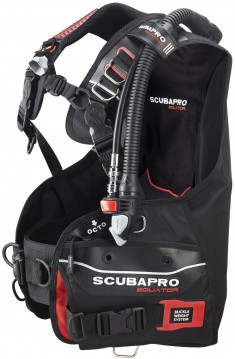
This is one of the first choices that you would have to make. Weight integrated BCD’s give you the option of putting your weights in designated pockets in your BCD, so that you don’t have to wear a weight belt anymore. Most BCD’s can handle about 10kg’s of weight in their pockets, so if you use more than that, you might still have to consider a light weight belt, to supplement the weights in your BCD.
When looking at a weight integrated BCD, consider these 2 things:
1.) All weight pockets come with an easy-release system (so that you can dump the weights if needed, as you could with a weight belt). Make sure the system works easy enough for you, and also check to see that it is easy enough to clip the pockets back in, once removed. The pockets should be clipped in securely – you don’t want to lose them on a dive.
2.) See if the BCD has got trim pockets at the back. These pockets are used to trim your weight distribution. If you do a dive, and you feel that your centre of gravity is too far forward, you can adjust this by removing weight from the front pocket, and adding it to the back – or visa-versa. Not all weight integrated BCD’s have these pockets, and they can really make a dive a lot more comfortable.
If you are looking at saving money, BCD’s that are not weight integrated are usually a bit cheaper. Before you buy though, consider the following:
a.) If you buy a BCD that is not weight integrated, how much is a weight belt going to cost you?
b.) Compare the cost between the weights that you could use for a weight integrated BCD, and the weights that you would have to buy for your weight belt.
As a final piece of advice on this subject – if you have a big belly, you will find that weight belts can be a nightmare, as they will more than likely tend to want to slip off – making weight integration the better choice.
Back-inflation (Wing) or Jacket Style inflation
This is something that comes down largely to peoples’ individual preferences. There are pro’s and con’s to each:
Back-inflation pro’s:
a.) You don’t get that squeezed feeling that you can get from jacket style BCD’s when you fully inflate the BCD. All the air goes into a “wing” at the back, and the bladder is loosely attached with a bungee cord, that stretches as the bladder inflates. The wing extends to the back, which leaves your ribcage untouched.
b.) It is a “more free” feeling, or a less cluttered feeling, than with a jacket style. If you like minimalism while diving, then you will probably enjoy this type of BCD.
c.) Your centre of gravity sits lower while you are diving in a horizontal position, which makes for a very comfortable dive.
Back-inflation con’s:
a.) If you fully inflate your BCD on the surface, it tends to want to push your face forward into the water. This can be bettered by not inflating the BCD all the way, but by only as much as is needed. Another way to combat this, is to lie halfway on your back, in order to correct your centre of gravity. A partially inflated BCD will have less of this forward tilting effect. If you are going to be spending a lot of time on the surface (as an instructor, for example), this is something you would have to take into consideration when buying a BCD.
Jacket style pro’s:
a) .If you do not mind the BCD inflating around your waist, these BCD’s are comfortable, above and below the water.
b.) Familiarity – most of us learned to dive in this BCD. There is no need to adjust to another type of BCD.
c.) It is easier to learn to dive in this type of BCD.
Jacket style con’s:
a.) Some makes can press your ribcage quite hard if they are fully inflated.
b.) More BCD around your waist – not as simplistic as a back-inflation style.
Travel VS Normal BCD’s
Travel BCD’s are becoming more and more popular. Advantages of a travel BCD are:
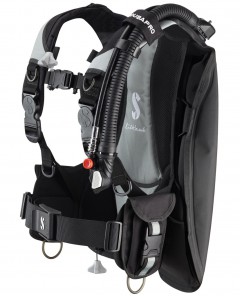
a.) Lightweight – when you travel, every kilo counts. Travel BCD’s have been designed to be light weight. Steel gets replaced with plastic, and back plates get taken out.
b.) They are easy to pack. Most of them can fold up quite small, as the back plate has been removed.
If you are looking for a BCD that you could use for diving on overseas holidays, this is what I would recommend. However, if you are looking for a BCD to do some serious diving, often – like working as an instructor, for example – I would not recommend a travel BCD, as they are not built with the same sturdiness as a normal BCD.
Male and female
Although some BCD’s are unisex, I would strongly recommend a BCD that is gender specific. Female BCD’s differ from male BCD’s in that the shoulders are narrower, the back plates tend to be more cushioned (very comfortable!), and the cut under the arm is different.
As a final note, my recommendation is that, when buying a BCD, go for the best quality that you can afford. A good quality BCD can last you ages, and can provide you with a very comfortable dive experience. Make sure that the BCD that you buy has enough “lift” for the purpose you are going to use it for – if you dive with a lot of weights, you want a BCD that can handle it easily. Quite often a BCD can be bought as part of a set special, which means that you might get it at a significantly reduced price as a part of a set with a regulator.


